The High-Stakes World of Modern Logistics
In the logistics and supply chain industry, timing isn’t just a metric—it is the entire business. Whether you are managing a fleet of trucks, coordinating international freight, or overseeing last-mile delivery, the margin for error is razor-thin. Yet, despite the high-tech nature of GPS tracking and warehouse management systems, many logistics firms still handle their sales, customer service, and lead nurturing through manual spreadsheets and fragmented email chains.
As a digital marketing consultant specializing in GoHighLevel automation and AI voice agents, I have seen firsthand how service-based businesses transform when they move from reactive manual work to a proactive CRM automation strategy. For logistics companies, this shift isn’t just about convenience; it’s about survival in an increasingly competitive global market.
What is a CRM Automation Strategy?
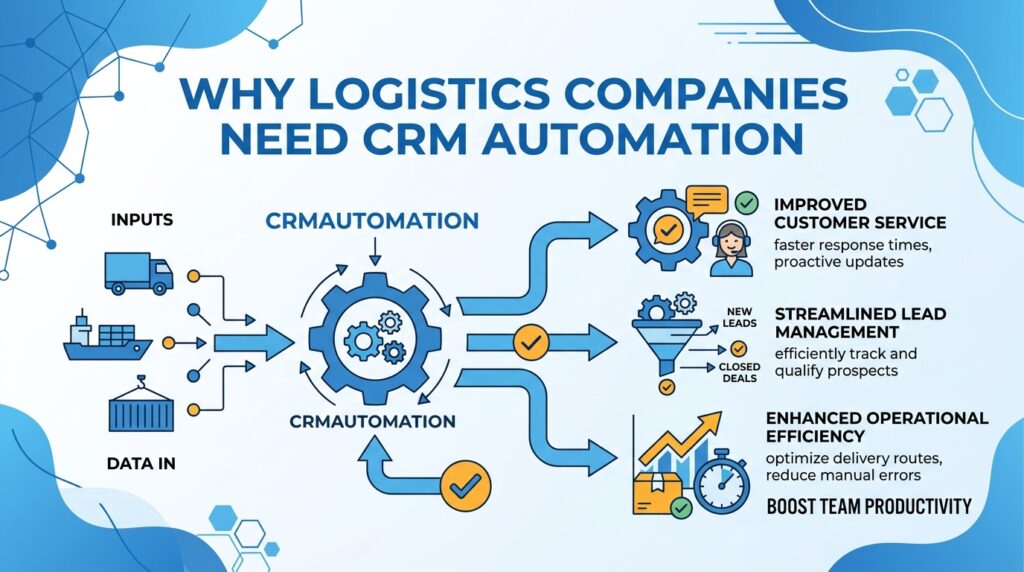
A CRM (Customer Relationship Management) automation strategy is the systematic use of software to handle repetitive tasks throughout the customer lifecycle. Instead of a sales representative manually following up with a freight broker or a customer service agent typing out the same shipping update fifty times a day, automation handles these touchpoints instantly and accurately.
By integrating tools like GoHighLevel, logistics companies can create a seamless flow of data from the moment a lead enters the funnel to the moment a shipment is delivered and a review is requested. This ensures that no lead falls through the cracks and every client feels like a priority.
1. Eliminating the ‘Lead Leak’ in Freight Sales
In logistics, speed to lead is everything. If a potential client requests a shipping quote and doesn’t hear back within minutes, they have already moved on to the next carrier. A robust CRM automation strategy uses automated responders to acknowledge inquiries instantly.
With GoHighLevel, we can implement workflows where a web form submission triggers an immediate SMS or an AI voice agent call. These AI agents can qualify the lead, ask for shipment dimensions, and even book a call on a sales rep’s calendar. This keeps your pipeline moving 24/7, even when your office is closed.
2. Streamlining Communication and Transparency
Logistics is notorious for communication bottlenecks. Shippers want to know where their cargo is, and brokers need constant updates. When these updates are handled manually, errors occur and staff get overwhelmed. Automation allows for triggered notifications based on pipeline stages.
When a shipment moves from ‘Dispatched’ to ‘In Transit’ in your CRM, an automated email or text can be sent to the client. This proactive transparency reduces the volume of inbound ‘Where is my stuff?’ calls, freeing up your team to focus on high-level problem solving rather than routine status reporting.
3. Nurturing Long-Term Partnerships
The most profitable logistics companies rely on recurring contracts, not just one-off shipments. However, maintaining relationships with hundreds of shippers and brokers is difficult without a system. A CRM automation strategy allows you to set up ‘long-term nurture’ sequences.
If a client hasn’t booked a load in 30 days, the CRM can automatically send a personalized check-in email or a special seasonal rate offer. This keeps your brand top-of-mind without requiring your sales team to manually track every dormant account in a spreadsheet.
4. Leveraging AI Voice Agents for Operations
One of the most exciting frontiers in logistics tech is the use of AI voice agents. These are not the frustrating ‘press 1 for sales’ robots of the past. Modern AI voice agents can conduct natural conversations to confirm delivery windows, verify pick-up locations, or even conduct post-delivery satisfaction surveys.
By integrating AI voice agents into your CRM strategy, you can automate the ‘grunt work’ of dispatching and check-calls. This ensures data is captured directly into your CRM in real-time, providing a single source of truth for the entire organization.
5. Data-Driven Decision Making
You cannot manage what you cannot measure. A centralized CRM like GoHighLevel provides a bird’s-eye view of your entire operation. You can see exactly which marketing channels are producing the highest-value freight leads, what your conversion rate is from quote to booking, and which account managers are performing best.
Without an automated strategy, this data is often buried in different silos. Automation pulls it all together, giving you the insights needed to scale your fleet or expand into new territories with confidence.
Conclusion: The Path to Scalable Logistics
The logistics industry is moving toward a future defined by efficiency and digital integration. Companies that continue to rely on manual data entry and fragmented communication will find themselves outpaced by leaner, automated competitors. Implementing a CRM automation strategy is the foundation for scaling your operations while maintaining a high level of customer service.
Whether you are looking to implement GoHighLevel for the first time or want to enhance your current setup with AI voice agents and advanced workflows, the goal is the same: work smarter, not harder.
Ready to streamline your logistics business? Stop losing leads and start automating your growth. Book a free strategy call with me today, and let’s build an automation engine that drives your business forward.