The Fortune is in the Follow-Up (But Most Businesses Are Failing)
In the world of service-based businesses—whether you are a contractor, a lawyer, or a clinic owner—a lead is only as valuable as your ability to close it. We’ve all been there: you spend money on Facebook ads or SEO, a lead comes in, and then… nothing. They don’t answer the first call, and they sit in your CRM gathering digital dust.
Statistics show that it takes between five to twelve touchpoints to convert a cold lead into a paying client. Yet, most business owners stop after one or two attempts. If you want to scale, you need a follow-up sequence that converts automatically. As a digital marketing consultant specializing in GoHighLevel automation and AI voice agents, I’ve seen firsthand how the right system can turn a ‘dead’ lead list into a goldmine. Here is how you build it.
1. Speed to Lead: The 5-Minute Rule
The first step in any follow-up sequence isn’t actually a sequence—it’s an immediate reaction. If you don’t contact a lead within the first five minutes of them opting in, your chances of qualifying them drop by 400%. This is where automation is non-negotiable.
Using a tool like GoHighLevel, you can trigger an immediate SMS and email the second a form is submitted. But we can go further. For my clients in high-ticket industries like law or home services, we implement AI voice agents. These agents can call the lead instantly, engage in a natural conversation, and live-transfer the call to your office or book an appointment directly on your calendar. When the lead is still thinking about their problem, you are already providing the solution.
2. The Multi-Channel Approach
A follow-up sequence that converts does not rely on a single medium. People have different communication preferences. Some prospects will ignore every email but reply to a text message within seconds. Others prefer a professional voicemail.
Your automated workflow should include:
- SMS/Text Messaging: High open rates (98%) and great for quick, informal questions.
- Email Marketing: Best for providing social proof, case studies, and long-form value.
- Ringless Voicemail (RVM): A non-intrusive way to stay top-of-mind.
- AI Voice Calls: To bridge the gap between automation and a human touch.
3. Day 1 to Day 30: Mapping the Cadence
A common mistake is front-loading all communication in the first 48 hours and then disappearing. A high-converting sequence needs a strategic cadence. Here is a proven framework for service-based businesses:
- Days 1-3 (The Aggressive Phase): Two touchpoints per day. Mix SMS, email, and a phone call. Focus on immediate pain points and the ‘Speed to Lead.’
- Days 4-10 (The Value Phase): One touchpoint every other day. Share a testimonial from a similar client or a ‘how-to’ guide relevant to your service.
- Days 11-30 (The Long-Term Nurture): One touchpoint per week. Focus on staying top-of-mind so that when they are finally ready to buy, you are the only name they remember.
4. Use AI Voice Agents to Break the Ice
One of the biggest hurdles in converting cold leads is the ‘outbound’ anxiety—your team doesn’t want to make 50 cold calls a day. This is where AI voice agents change the game. Unlike a standard robocall, modern AI voice technology can understand intent, handle objections, and speak with a human-like cadence.
By integrating an AI agent into your GoHighLevel workflow, you can automate the ‘discovery’ call. The AI can ask, ‘I saw you were looking for a roof replacement quote; do you know how many square feet your home is?’ Once the lead is engaged and qualified, the AI moves them to the next stage of your funnel. This ensures your human staff only spends time talking to leads who are actually ready to buy.
5. Personalization and Segmentation
A generic ‘Are you still interested?’ email is a one-way ticket to the spam folder. To convert cold leads, your follow-up must feel personal. Use merge tags in your automation to reference their specific project or location. For example, a law firm might segment leads by ‘Personal Injury’ vs. ‘Family Law,’ ensuring the follow-up content is 100% relevant to the lead’s specific legal struggle.
6. The ‘Break-Up’ Email
If a lead hasn’t responded after 30 days, it’s time for the ‘Break-Up’ email. This is often the highest-converting message in the entire sequence. It usually goes something like this: ‘Since I haven’t heard back, I assume your priorities have shifted or you’ve found another solution. I’m going to close your file for now. If you ever need help in the future, you know where to find me.’
This triggers a psychological response known as loss aversion. If they were simply busy, they will often reply immediately to keep the door open.
Ready to Automate Your Growth?
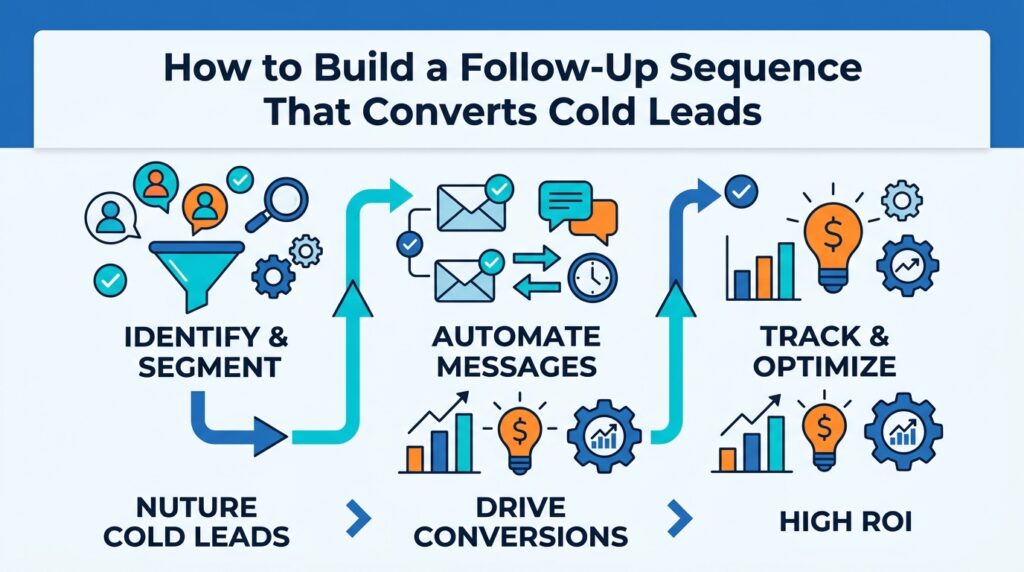
Building a follow-up sequence that converts requires the right strategy and the right tech stack. Whether you are a contractor looking to fill your calendar or a clinic wanting to reduce no-shows, automation is the key to scaling without increasing your workload. Stop letting leads slip through the cracks and start turning your CRM into a revenue-generating machine.
Are you ready to see how GoHighLevel and AI voice agents can transform your business? Book a free strategy call with me today, and let’s build an automated system that works for you 24/7.